FHA Streamline Refinance: The Fastest Way to Lower Your Payment
No appraisal, usually no income verification, and it can close in a couple of weeks. The FHA Streamline is the easiest refinance there is. The hard part is knowing whether it actually helps you, and most of the confusion lives in the closing costs.

Licensed Mortgage Broker

If you have an FHA loan and rates have come down since you bought, you have access to the easiest refinance there is.
No appraisal. In most cases no income verification and no credit based qualification. It can close in a couple of weeks when the paperwork moves quickly. That combination is genuinely unusual, and it is why the FHA Streamline is worth understanding even if you are not planning to refinance tomorrow.
But the easy part is not the valuable part. The valuable part is knowing whether it actually helps you, because the answer is not always yes, and the thing that confuses people most is not the rate. It is the closing costs.
Here is how it actually works.
What makes it a streamline
The name refers to the documentation and underwriting, not to the absence of costs. HUD is explicit about that.
Two versions exist, and one dominates in practice.
- Non credit qualifying. The common version. No credit based qualification, no income documentation, no debt to income calculation. The lender is essentially confirming that you have an FHA loan, that you have paid it, and that the new loan helps you.
- Credit qualifying. Full review of income and credit. Mostly used when a borrower needs to be added to or removed from the loan, since changing who is obligated requires qualifying the person who remains.
There is no appraisal on either. A version with an appraisal existed years ago and was eliminated. Today the new loan amount is based entirely on your existing balance rather than on what the house is worth.
That cuts both ways. You avoid the appraisal fee and the risk of a value that comes in short. You also cannot touch any equity you have built since you bought, no matter how much the home has appreciated.
When you are eligible, and the rule that trips people up
The seasoning requirements are straightforward on paper:
- At least six payments made on the current FHA loan
- At least six months since the first payment due date
- At least 210 days since the original closing
Here is the one that catches people. You cannot close until the first of the month following the month your sixth payment was due and made.
So a borrower who counts 210 days from closing, sees the date has passed, and assumes they can close that week is often wrong. The payment month governs, and it frequently pushes the earliest closing date later than the day count suggests.
Worth checking before you lock a rate, since a lock that expires before you are eligible to close is a cost you did not need.
The net tangible benefit
FHA will not let you refinance unless the new loan measurably helps you. The test uses the combined rate, meaning the note rate plus the annual mortgage insurance rate, not the note rate alone.
- Fixed to fixed: the combined rate must fall by at least half a percentage point. This is where the large majority of streamlines land.
- ARM to fixed: qualifies even if the combined rate goes up, as long as it rises no more than two percentage points. FHA treats the stability of a fixed rate as a benefit in itself.
- Fixed to ARM: the combined rate must fall by at least two percentage points.
- Shortening the term: reducing a fixed rate loan term by three years or more can qualify without the half point reduction. The monthly savings are usually smaller or nonexistent, since a shorter term raises the principal portion of the payment.
The ARM to fixed case is the one people find surprising. A borrower whose adjustable rate is about to reset can move into a fixed rate at a slightly higher number and still clear the test, because what they are buying is predictability.
The mortgage insurance picture
This is where a streamline gets misjudged most often, in both directions.
The upfront MIP refund. If you refinance within three years of your original FHA loan, you receive a prorated refund of the upfront mortgage insurance premium you paid. It is not cash back. The refund is applied against the payoff of your existing loan, which lowers the new loan amount. The earlier you refinance within that window, the larger it is.
The new loan carries current MIP. A streamline does not remove mortgage insurance. The new loan is an FHA loan and carries FHA mortgage insurance under today's guidelines.
The total effective rate is what matters. Not the note rate, not the MIP rate, but the two together. That is the number that determines your payment, and it is the number the net tangible benefit test uses for a reason.
Closing costs cannot be financed
This is the part that surprises almost everyone, and it is the most important thing in this post.
On most refinances, you can roll closing costs into the new loan. On an FHA Streamline without an appraisal, you cannot. The maximum loan amount follows a strict formula, and closing costs sit entirely outside it.
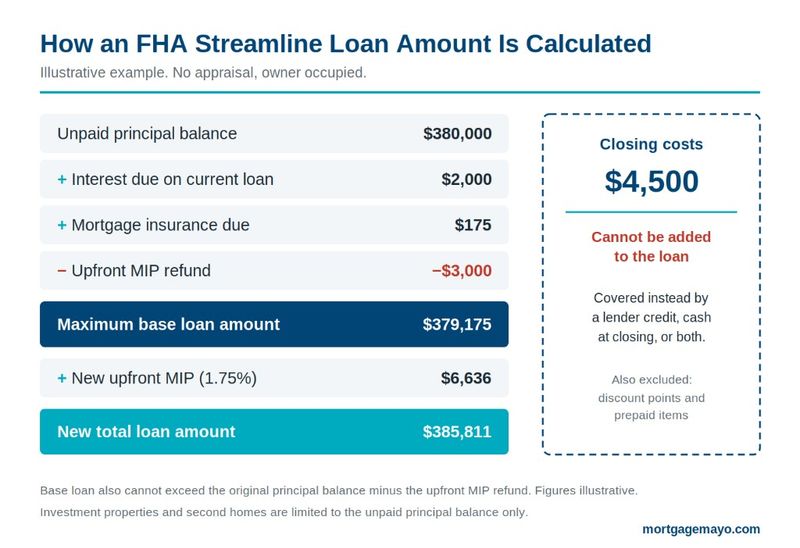
The formula works like this:
- Start with your unpaid principal balance
- Add interest and mortgage insurance due on the current loan
- Subtract the upfront MIP refund, if you are within three years
- That is your maximum base loan amount, which also cannot exceed your original principal balance minus the refund
- Add the new upfront MIP on top to reach the total loan amount
Closing costs, discount points, and prepaid items are not in that math anywhere. They have to be paid another way.
The practical consequence is that "no appraisal, no income docs" does not mean "no money needed." It means the money is needed somewhere other than the loan amount.
How the costs actually get covered
There are a few ways to handle cash to close, and each deserves an honest description.
A lender credit. You choose a slightly higher rate, and the lender pays you a credit that offsets closing costs. This is the most common approach and often the cleanest. The catch is that it works better when rates have fallen substantially. In an elevated rate environment, the room between a rate that clears the net tangible benefit test and a rate high enough to generate a meaningful credit gets narrow, and sometimes it closes entirely.
Deferring two payments. Because of how interest is paid on a mortgage, the timing of a refinance can let you go a month or two without a scheduled payment. This is real, and it reduces what you need at closing. But be clear eyed about it. Those payments are not skipped. The interest is either paid at closing or built into the new loan. They are deferred.
The escrow refund. When your old loan is paid off, the servicer refunds whatever is left in your escrow account. That can offset money you bring to closing. It is a genuine help with cash flow, and it is also your own money coming back to you rather than a benefit of the transaction.
None of these are unique to streamlines. They exist on most refinances. They matter more here because the loan amount cannot absorb the costs directly.
Handled well, a streamline can close with little or nothing out of pocket. Handled badly, a borrower expecting a free refinance finds a four figure number on the closing disclosure. The difference is knowing about it at the start.
It is also exactly why getting more than one quote matters. Two lenders offering the same rate on the same streamline can structure the credit very differently, which I wrote about in the post on how a second opinion saved one client $15,000.
Should you leave FHA entirely instead
A common question, and the answer is less obvious than it seems.
If you have built enough equity, refinancing into a conventional loan can remove mortgage insurance altogether. That sounds like an automatic win, and a lot of borrowers treat mortgage insurance as something to escape at any cost.
It is not automatic, because mortgage insurance is a tool rather than a penalty. The right comparison is the total monthly payment and the total cost, not whether mortgage insurance appears on the statement.
Two things make this matter:
- Conventional pricing depends heavily on credit and equity. A borrower with a modest score or limited equity can find that a conventional rate without mortgage insurance produces a higher payment than an FHA rate with it.
- Borrowers with very low rates from 2020 and 2021 rarely benefit. If your note rate is already exceptionally low, adding today's rates to escape mortgage insurance usually costs more than the mortgage insurance does. Removing it is not worth giving up a rate you will not see again.
Look at the whole picture. A streamline that keeps mortgage insurance but lowers your payment can beat a conventional refinance that removes it.
Investment properties and second homes
Streamlines are allowed on investment properties and second homes, and they are genuinely uncommon for good reason.
The loan amount is limited to the unpaid principal balance only, without the interest and mortgage insurance that owner occupied loans can include. The new loan must be a fixed rate. The combination makes the math noticeably less favorable, and most borrowers in that position have better options.
When a streamline is not worth doing
The honest counterweight, because the ease of the process can make a streamline look better than it is.
- When the savings do not cover the costs in time. If closing costs are real and the monthly savings are small, calculate how long it takes to break even. If you plan to sell or refinance again before then, you lose money.
- When you are chasing the ARM to fixed benefit without needing it. Moving to a fixed rate at a higher combined rate is worth it when a reset is coming that you cannot absorb. It is not free insurance otherwise.
- When a conventional refinance genuinely wins. Sometimes it does, particularly with strong credit and substantial equity. Run both.
- When rates have barely moved. Clearing the half point threshold with nothing left over for a lender credit usually means bringing cash to closing for a modest improvement.
- When you are counting on the deferred payments as savings. They are timing, not money. If the refinance only works because two payments seem to disappear, it does not work.
The short version
The FHA Streamline is the fastest refinance available, and for a lot of FHA borrowers it is genuinely worth doing when rates move. But the value depends on three things most people never check: whether you clear the net tangible benefit on the combined rate, what your actual cash to close is once you understand that costs cannot be financed, and whether your break even point arrives before you expect to move.
The payment calculator will get you close on the monthly side. The cash to close is the part that needs someone to actually run it, and it is the part that decides whether the refinance was worth it. The refinance guide covers how this fits against your other options, and the full range of loan programs is broader than most FHA borrowers are shown.
Frequently Asked Questions
What is an FHA Streamline refinance?
Do I need an appraisal for an FHA Streamline?
How soon can I do an FHA Streamline after buying?
What is the net tangible benefit for an FHA Streamline?
Can I roll closing costs into an FHA Streamline?
Will I get my upfront MIP back on an FHA Streamline?
Does an FHA Streamline remove mortgage insurance?
Can I do an FHA Streamline on an investment property?
Have an FHA Loan and Wondering Whether a Streamline Makes Sense?
Send me your current rate and loan balance. I will run the net tangible benefit test, show you the real cash to close, and tell you plainly whether it is worth doing right now.
Get Started

