FHA vs. Conventional: Which Loan Is Actually Better for You?
Everyone has an opinion on FHA vs. conventional. Most of those opinions are wrong. The right answer depends on your credit score, your down payment, how long you plan to keep the loan, and whether the property is a condo. Here's the real comparison.

Licensed Mortgage Broker

"Just go FHA. It's easier."
That's what most first-time buyers hear from friends, family, and sometimes even their loan officer. And sometimes it's true. But "easier to qualify for" and "better for you" aren't the same thing. I see buyers default to FHA when conventional would save them thousands. And I see buyers chase conventional when FHA is the smarter move for their situation.
The right answer depends on five things: your credit score, your down payment, how long you plan to keep the loan, whether the property is a condo, and whether you have student loans. Let me walk through each one.
The Quick Comparison
Before I get into the details, here's the summary:
FHA requires a minimum 580 credit score (or 500 with 10% down). Conventional technically has no minimum credit score anymore. The automated underwriting system (AUS) evaluates the full risk profile of your file, including credit, income, assets, and DTI together. A higher score gives you a better chance of AUS approval, and in practice, most approvals happen above 620. Below 620, it's nearly impossible to get private mortgage insurance, which means you'd need 20% down to avoid it. FHA lets you put down as little as 3.5%. Conventional goes as low as 3% for first-time buyers. FHA has an upfront mortgage insurance premium of 1.75% plus annual MIP of 0.55% for the life of the loan (unless you put 10%+ down, in which case it drops off after 11 years). Conventional has PMI that varies by credit score and LTV, but it drops off automatically at 20% equity. FHA allows higher DTIs (up to 50%+ with compensating factors). Conventional maxes out around 45-50%.
On the surface, FHA looks more accessible. And it is, for some borrowers. But the mortgage insurance difference is where the real cost lives.
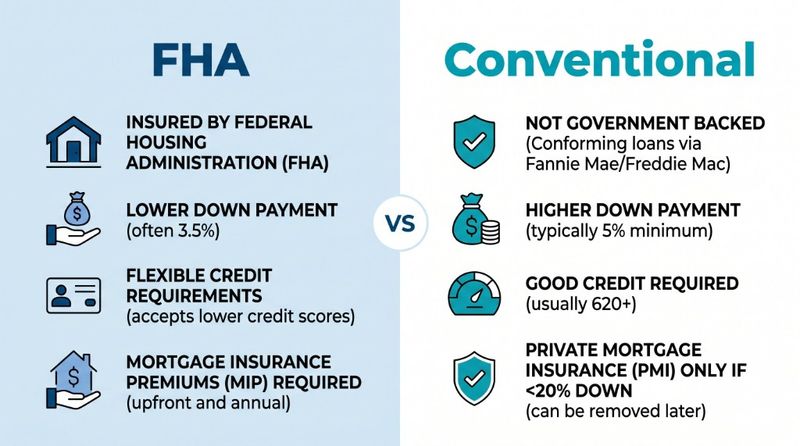
Note: Conventional credit requirements have recently changed. There is no longer a hard 620 minimum. AUS evaluates the full risk profile. See details below.
Mortgage Insurance: This Is Where the Money Is
This is the single biggest factor in the FHA vs. conventional decision, and it's the one most buyers don't fully understand.
FHA mortgage insurance has two components. The upfront MIP is 1.75% of the loan amount, typically rolled into the loan. On a $400,000 loan, that's $7,000 added to your balance. Then there's the annual MIP of 0.55%, paid monthly. On that same $400,000 loan, that's about $183/month.
Here's the catch: if you put less than 10% down (which most FHA buyers do), that monthly MIP stays for the entire life of the loan. The only way to get rid of it is to refinance into a conventional loan once you've built enough equity.
Conventional PMI works differently. First, you only pay it if you put less than 20% down. Second, the cost varies based on your credit score and LTV. A buyer with a 740 credit score putting 5% down might pay PMI of $80-$100/month on a $400,000 loan. A buyer with a 660 score putting 3% down might pay $200+/month. Third, and most importantly, PMI drops off automatically when you reach 20% equity. No refinance needed. It just goes away.
Over time, this difference adds up to thousands of dollars. A buyer who stays in the home for 7-10 years and builds equity will pay significantly more in total mortgage insurance on an FHA loan than on a conventional loan, assuming their credit score is strong enough to get a competitive PMI rate.
When FHA Wins
FHA isn't the wrong choice. For certain borrowers, it's the clear winner.
Credit scores below 680. This is where FHA starts to pull ahead. Conventional PMI costs rise steeply as credit scores drop below 700. At a 640 credit score, your conventional PMI rate could be 1.5-2% of the loan amount annually, which is more expensive than FHA's 0.55% MIP. The crossover point is roughly in the 680-700 range. Below that, FHA's mortgage insurance is often cheaper month-to-month even though it lasts longer.
Higher DTI ratios. If your total debts (including the new mortgage) eat up 46-50% of your gross income, FHA is more forgiving. Conventional loans get tighter above 45% DTI. FHA's more flexible DTI limits can be the difference between qualifying and not qualifying.
Credit events in the recent past. Had a bankruptcy? FHA requires only 2 years of seasoning after a Chapter 7 discharge (versus 4 years for conventional). Foreclosure? FHA requires 3 years (versus 7 for conventional). If you've had a significant credit event and want to buy sooner, FHA gets you back in the market faster.
Smaller down payment with lower credit. FHA at 3.5% down with a 580 credit score is a combination that conventional struggles to match. While conventional no longer has a hard minimum score, getting AUS approval below 620 is difficult, and getting mortgage insurance below 620 is nearly impossible. That effectively means a conventional borrower under 620 needs 20% down. FHA's 3.5% at 580 is a much more accessible path for buyers with limited savings and lower credit.
Gift funds for the entire down payment. Both FHA and conventional allow gift funds, but FHA is more flexible about the source and documentation of those gifts. If your entire down payment is coming from a family member, FHA may have a smoother path.
When Conventional Wins
Credit scores above 700. Once your score crosses into the 700s, conventional PMI becomes very affordable, often $60-$120/month on a standard loan. At 740+, the PMI is minimal and your rate tier is excellent. Combined with the fact that PMI drops off at 20% equity, conventional saves you money both month-to-month and long-term.
You plan to stay in the home more than 5 years. The longer you own the home, the more the PMI-drops-off advantage compounds. An FHA borrower who stays 10 years pays MIP every single month. A conventional borrower who hits 20% equity in year 6 or 7 stops paying mortgage insurance entirely and keeps that savings for the remaining years.
You're buying a condo. FHA has stricter condo warrantability requirements than conventional. The condo complex has to be FHA-approved or pass a Single Unit Approval, which checks the association's financials, reserves, owner-occupancy ratios, and litigation status. Many older complexes (especially in markets like Long Beach and Orange County) don't meet FHA standards. Conventional loans have warrantability requirements too, but they're less restrictive. If the condo you want isn't FHA-eligible, conventional is your path.
You have student loans. As I covered in a previous post, FHA uses a 0.5% of balance calculation for student loans in deferment or with $0 payments. Conventional can use the actual $0 IBR payment from your credit report. On $100,000 in student loans, that's the difference between $500/month counted against your DTI (FHA) and $0 (conventional). That gap can mean qualifying for $50,000-$75,000 more in purchase price.
You want to avoid the upfront MIP. The 1.75% upfront premium on FHA adds about $7,000 to a $400,000 loan. That's money that goes straight to mortgage insurance, not equity. Conventional has no upfront mortgage insurance premium.
The Broker Play: Why Not Both?
Here's what I do for every buyer who comes in assuming they need FHA: I run both.
I pull your credit, collect your income docs, and run the scenario through both FHA and conventional guidelines. I compare the monthly payment (including mortgage insurance), the total cost of mortgage insurance over the time you expect to keep the loan, the impact on your DTI, and which properties each loan type makes available to you (especially for condos).
Sometimes FHA wins by $50/month and the answer is obvious. Sometimes conventional saves you $200/month in year one and $400/month after PMI drops off in year 7. Sometimes FHA is the only option because of credit or DTI. The point is: you need to see both numbers before you decide.
Most banks offer one or the other, or they push whichever product they're more comfortable with. As a broker, I have access to both FHA and conventional through 150+ wholesale lenders, and I have no incentive to push you toward either one. My job is to show you the math and let the numbers decide.
The FHA-to-Conventional Strategy
There's a smart middle path that a lot of first-time buyers miss: start with FHA, then refinance to conventional once you've built equity and improved your credit.
If you can't qualify for conventional today (credit too low, DTI too high, limited savings), FHA gets you into the home now. You start building equity through payments and appreciation. In 2-3 years, your credit has improved, you've built 10-15% equity, and you refinance into a conventional loan. The refinance eliminates the FHA MIP, potentially gets you a better rate, and resets your mortgage insurance clock.
This isn't a theoretical strategy. I've done it with multiple clients. The key is going in with a plan: knowing that FHA is step one, not the permanent state, and working on your credit during those first couple of years so the conventional refinance is ready when the time comes. And if rates drop before your credit is there, an FHA Streamline refinance can lower your payment in the meantime without starting over.
What About Multi-Unit Properties?
The FHA-vs-conventional decision gets even more interesting when you're buying a 2-4 unit property and planning to live in one of the units. FHA allows 3.5% down on multi-unit owner-occupied purchases (a duplex is the sweet spot — triplexes and fourplexes get tripped up by FHA's self-sufficiency test). Conventional allows as little as 5% down on a 2-unit and lets you avoid lifetime mortgage insurance. Either way, the lender can use 75% of projected rental income from the other units to help you qualify, which often makes a multi-unit purchase more affordable than a comparably priced single-family home. See the full multi-unit / house hacking playbook for how the math works and how to choose between FHA, conventional, and VA on a 2-4 unit deal.
Frequently Asked Questions
Is FHA or conventional better for first-time buyers?
What credit score do I need for FHA vs. conventional?
Does FHA mortgage insurance ever go away?
Is the FHA interest rate lower than conventional?
Can I switch from FHA to conventional later?
Why would my loan officer push FHA over conventional?
Does the loan type affect my offer strength when buying?
Have Questions About Your Mortgage?
Whether you're buying, refinancing, or investing — I'm here to help you navigate your options with clarity.
Get Started

